



Why General C.G. Musa Is the Right Defence Minister for Nigeria—Right Now
 King Richard Igimoh, Group Editor ALODecember 2, 20253 Mins read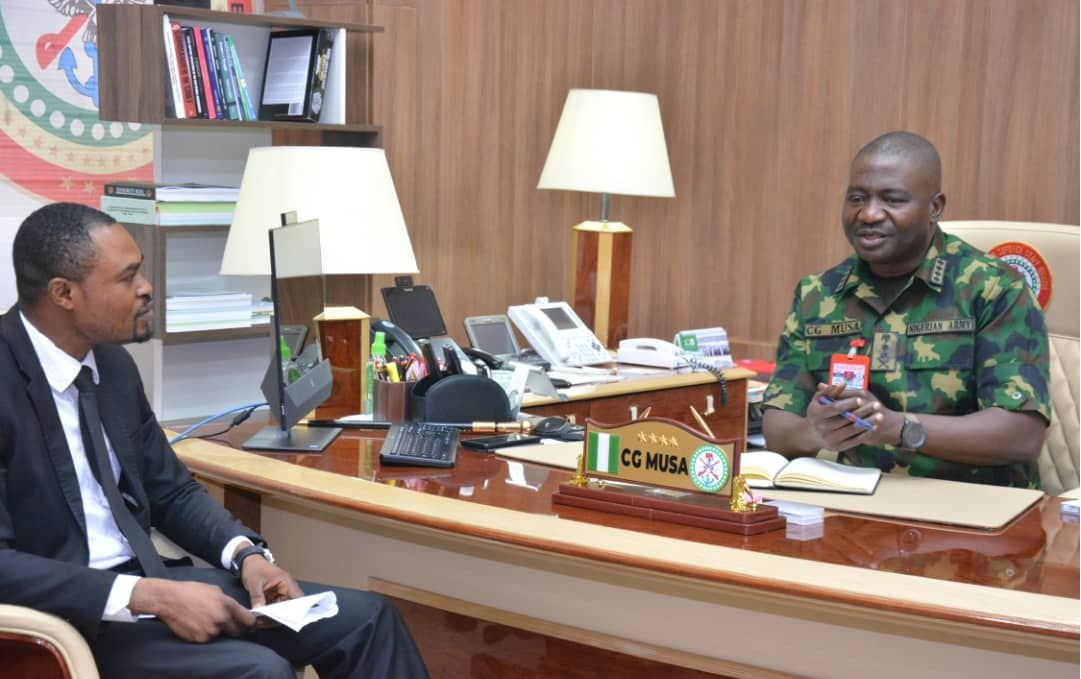
President Bola Tinubu’s nomination of General Christopher Gwabin Musa (rtd.) as Minister of Defence comes at a moment when the nation urgently requires a leader who understands both the physical terrain of its conflicts and the global dynamics shaping them. Few figures meet that dual requirement as precisely and convincingly as Musa.
This is not simply because he once served as Chief of Defence Staff (CDS). It is because of how he served, what he delivered, and how far his influence now extends.
A Field-Tested Strategist for a Volatile Moment
When General Musa became CDS on 19 June 2023, he arrived not as a bureaucratic commander but as a frontline strategist shaped in the toughest theatres of Nigerian warfare—most notably Operation Hadin Kai in the North-East.
His approach blended firm military pressure with stabilisation tools: robust community engagement, inter-agency cooperation and strict adherence to human-rights rules of engagement.
Across almost two years in office, this doctrine yielded measurable results. Insurgent safe spaces shrank. Intelligence-driven joint operations disrupted logistics networks. Community collaboration increased. The scale of surrenders, rescues and operational disruptions during his tenure was significant enough that many defence analysts described it as a doctrinal shift, not simply another command cycle.
Musa’s philosophy was clear, rooted in his upbringing in Sokoto:
“We were taught to live, respect, and accommodate each other… I don’t believe in differences in religion and tribes. First, we are human beings, we are Nigerians.”
In practice, this belief became strategy. He treated communities as partners, not spectators. He recognised that asymmetric warfare requires not only firepower but presence, protection and persuasion. In several theatres, that mindset changed the course of the fight.
A Leader Who Understands the Human Cost — and the Human Terrain
General Musa stood out for his empathy as much as his operational discipline. Unlike many commanders, he openly acknowledged the emotional and psychological burdens carried by troops and their families.
His candour—“For 17 years of my marriage, I never had 30 straight days with my family”—resonated across the ranks. It strengthened trust, improved morale and helped reduce desertion rates. Communities also began to see soldiers less as occupiers and more as partners.
In an era where counterinsurgency depends on trust as much as tactical superiority, this human-centred leadership mattered enormously.
Nigeria’s security challenges no longer exist in isolation. They are shaped by shifting alliances, evolving extremist networks and a rapidly transforming Sahel.
The U.S. footprint is changing. Non-Western actors are expanding. ECOWAS is under pressure.
In such an environment, Nigeria requires a Defence Minister capable of operating confidently in tactical, diplomatic and multilateral spaces. Musa already does.
His international recognition—including the Colin Powell Meritorious Award—signals a leadership profile respected beyond the continent. As CDS, he deepened multinational cooperation on counter-terrorism, peacekeeping and migration security.
In 2025, he was appointed to the Board of Governors of the U.S.-based Midlothian Angel Network, reflecting global confidence in his integrity and strategic judgment.
These are not common credentials. They represent the type of credibility modern defence diplomacy demands.
Nigeria’s current security landscape is once again becoming fragile:
- Fresh ISWAP ambushes in the Northeast
- Escalating banditry in the North-West
- Persistent oil-theft losses in the Niger Delta
- Extremist realignments across the Sahel
Transitional political periods often create vulnerabilities, but today’s moment is uniquely precarious, with the region’s alliances, threats and partners all in flux.
This is not the time for trial-and-error leadership.
It is a time for experience—specifically, field-tested, community-aware, internationally credible experience.
Musa offers all three.
If the Defence Minister’s role is to safeguard the homefront while modernising the long-term architecture of national security, then Musa brings a rare combination of competencies:
- Command experience in both theatre and national operations
- Deep familiarity with asymmetric warfare
- A temperament suited to repairing civil-military relations
- International respect Nigeria can strategically leverage
- A philosophy that treats security as a shared national responsibility
As one ECOWAS security official put it:
“Nigeria must lean on its strategic depth. It needs leaders who understand both the terrain and the geopolitics.”
Musa fits that description.
Nigeria needs a Defence Minister who can stabilise domestic threats, strengthen regional alliances, modernise the military’s posture and command international respect. General C.G. Musa has shown consistent competence in all these areas.
His nomination is not only timely—it is strategic.
In an unpredictable security environment, Nigeria needs a steady, proven hand.
General Musa is that hand.


Related Articles
DIPLOMACY, PEACE & CIVIL SECURITY – CROSS-BORDER PEACE PACTS IN EAST AFRICA: SUCCESS OR FAILURE?
From the windswept Karamoja hills to the fishing villages of Lake Victoria,...
ECOWAS MILITARY INTERVENTION IN NIGER: A TURNING POINT?
The coup d’état in Niger on July 26, 2023, marked a seismic...
CIVIL-MILITARY RELATIONS IN FRAGILE STATES
Fragile states marked by weak governance, economic instability, and persistent unrest face...


WHY AFRICA NEEDS A UNIFIED DEFENCE POLICY FOR THE 21ST CENTURY
In an era of escalating geopolitical tensions, resource conflicts, and transnational threats...
