





THE CASE FOR CONTINENTAL BORDER SECURITY STANDARDS
 King Richard Igimoh, Group Editor ALODecember 27, 20252 Mins read
Africa’s borders remain both an opportunity and a liability. They enable trade, migration, and cultural exchange, but their weak management also allows transnational threats to spread with ease. Terrorism, arms trafficking, human smuggling, and organized crime thrive in poorly governed frontier zones, while unresolved boundary disputes continue to spark local conflicts. Despite long-standing efforts by the African Union (AU) to promote coordinated border management, uneven national approaches have limited impact. This gap has strengthened the argument for binding continental border security standards that apply across all 55 AU member states.
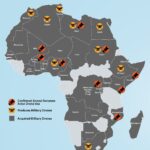
Africa’s security challenges rarely stop at national frontiers. In the Sahel, militant groups move freely across borders linking Mali, Burkina Faso, Niger, and Nigeria, sustaining operations through cross-border trafficking networks. In East Africa, al-Shabaab has exploited coastal and land routes to stage attacks and evade pursuit. West Africa faces growing pressure from banditry and migrant smuggling corridors that stretch across several countries. Recent tensions along borders such as Ethiopia–Sudan and Uganda–South Sudan have shown how poorly defined or weakly governed boundaries can escalate into violence and humanitarian crises. Without common rules and procedures, states respond unevenly, leaving gaps that criminal and extremist networks exploit.
Related Articles: THE RED SEA AND HORN OF AFRICA: HOTSPOTS OF MARITIME CONFLICT
The AU Border Programme (AUBP), launched in 2007, laid important groundwork. Its focus on border delimitation and demarcation, cross-border cooperation, and capacity building remains relevant. However, progress has been slow. Of Africa’s roughly 83,000 kilometers of land borders, only a limited portion has been fully demarcated, despite multiple deadline extensions. The AU’s 2020 Integrated Border Governance Strategy reframed borders as tools for peace, security, and integration under Agenda 2063, but implementation depends largely on voluntary national action. Key legal instruments, such as the Niamey Convention on cross-border cooperation, still have low ratification rates.
Regional Economic Communities (RECs) have filled some gaps, but their approaches vary widely. ECOWAS has advanced coordinated border management in parts of West Africa, while the East African Community and SADC emphasize trade facilitation alongside security. In the Horn of Africa, IGAD’s 2025 launch of a Technical Coordination Mechanism on Border Governance marked progress toward shared practices. Yet Africa’s overlapping REC memberships and differing priorities create fragmentation. What works in one region may not exist in another, reinforcing the case for continent-wide benchmarks that set minimum standards while allowing regional flexibility.
A unified continental framework would improve interoperability among border agencies. Shared standards for data collection, intelligence exchange, and joint patrols would make it harder for threats to exploit jurisdictional seams. Platforms that track foreign terrorist fighters, smuggling routes, and trafficking networks would be more effective if built on common protocols. Continental standards could also guide the adoption of technology biometric identification, smart border posts, and AI-assisted surveillance while embedding safeguards for privacy and human rights in migration management.
The economic case is equally strong. Weak borders undermine the African Continental Free Trade Area (AfCFTA) by enabling smuggling, revenue leakage, and non-tariff barriers that raise costs for legitimate traders. Secure and predictable border procedures would reduce delays, encourage formal trade, and help unlock the AfCFTA’s potential to expand intra-African commerce. At the same time, curbing illicit trade would cut off funding streams for armed groups and criminal syndicates.
Obstacles remain. Many states face resource constraints, shortages of trained personnel, and concerns over sovereignty. Corruption at border posts continues to weaken enforcement. Still, partnerships with international organizations such as GIZ, IOM, and UNODC show that targeted capacity building can deliver results. Recent AUBP initiatives including technical guidebooks and youth engagement programs suggest growing momentum.
Continental border security standards are no longer a theoretical ambition. They are a practical requirement for stability, integration, and growth. By anchoring national and regional efforts in common rules, the AU can help transform Africa’s borders into managed spaces that protect citizens, support trade, and limit the reach of transnational threats.





Related Articles

BORDER SECURITY – LESSONS FROM ECOWAS BORDER MANAGEMENT STRATEGIES
Since its founding in 1975, the Economic Community of West African States...

COMMUNITY INTELLIGENCE AT BORDERS: SUCCESSES AND FAILURES
Border security increasingly relies on community intelligence the collection and use of...
REFUGEE MOVEMENTS AND BORDER FORCE DILEMMAS
In today’s world of conflict, climate change, and widening economic divides, refugee...



BIOMETRIC BORDERS: AFRICA’S EXPERIMENTS IN SMART SECURITY
Africa is undergoing a quiet transition in border management. Across the continent,...
