




AFRICA’S ROBOTICS REVOLUTION ON THE BATTLEFIELD
 King Richard Igimoh, Group Editor ALODecember 15, 20253 Mins read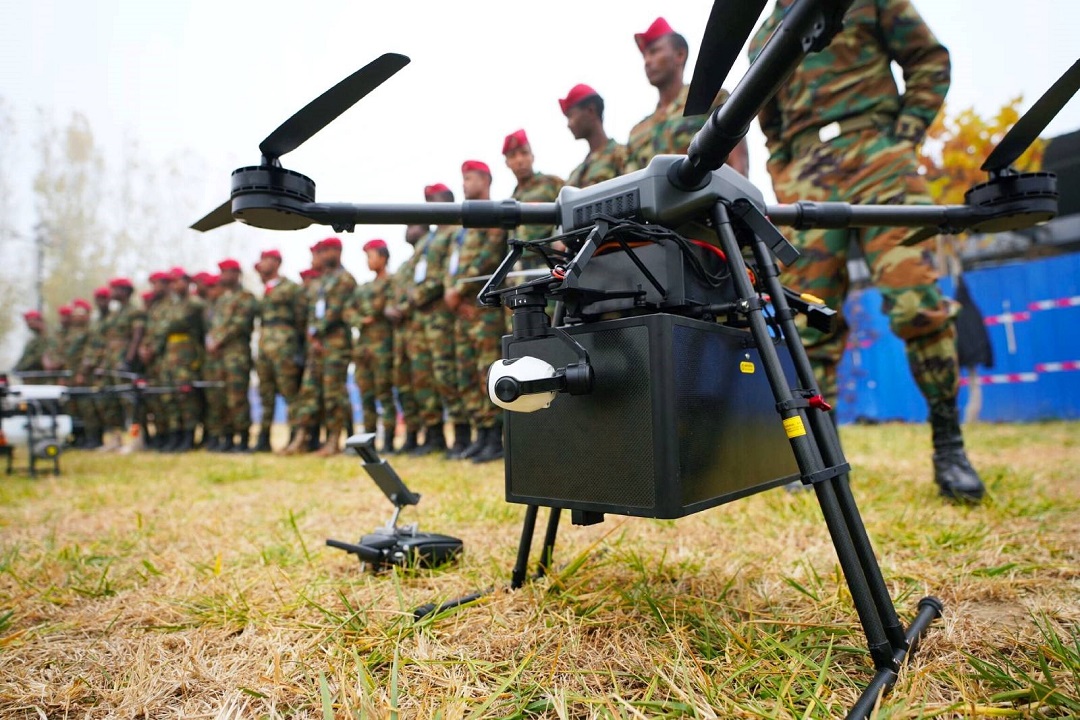
Across Africa’s conflict zones from the Sahel’s desert plains to the forests of the Democratic Republic of Congo a quiet technological shift is underway. Unmanned ground vehicles (UGVs), loitering munitions, and autonomous drones are no longer futuristic concepts; they are already influencing how African militaries operate. South African firms such as Milkor and Paramount Group export armed drones and robotic weapon stations, while Nigerian forces have deployed Turkish Bayraktar TB2s and Chinese Wing Loong drones in operations against Boko Haram. During Ethiopia’s Tigray conflict and in Sudan’s ongoing fighting, both sides adapted commercial quadcopter to drop small explosives, demonstrating how low-cost robotics can challenge better-equipped opponents.
The appeal of battlefield robotics for African militaries is practical and immediate. Countries face vast territories, limited personnel, and long supply routes conditions that make traditional patrols both risky and expensive. A single armed UGV can monitor a remote border for days using minimal fuel, while loitering munitions allow financially strained militaries to target high-value threats far from the front lines without risking pilots. Morocco’s recent purchase of Israeli Harop drones and Algeria’s reported interest in Russian Lancet systems highlight a regional shift: states unable to afford large mechanised forces are turning to robotics for asymmetric advantage.
Related Article: SYSTEMS & TECHNOLOGY – 3D PRINTING AND AFRICA’S DEFENCE INDUSTRY REVOLUTION
Cost is both the attraction and the challenge. Entry-level military drones from China or Türkiye may cost under $3 million far less than a modern fighter jet and their upkeep is generally simpler. However, the full ecosystem needed to operate them effectively secure communications, trained personnel, resilient data links, and spare parts adds significant expense. Several African militaries learned during recent operations that even a well-built drone becomes unusable when satellite links are jammed or ground control nodes are attacked. Dependence on foreign software updates and encryption keys also raises concerns about remote “kill switches” or hidden vulnerabilities controlled by supplier nations.
To reduce these risks, indigenous development is slowly gaining momentum. South Africa’s defence ecosystem around Pretoria retains deep experience from earlier unmanned programmes, and companies like DCD Protected Mobility now integrate AI-assisted turrets on vehicles derived from the Casspir. Rwanda has partnered with Turkish firms to build a drone assembly facility, while Uganda’s Luwero Industries produces small surveillance UGVs using 3D-printed components and imported electronics. In North Africa, Egypt’s Arab Organization for Industrialization is reverse-engineering recovered drones and developing a family of tactical UGVs under its “Sinai-100” initiative.
However, training remains a major bottleneck. Modern unmanned systems require expertise in software, sensors, data analysis, and electronic warfare skills still in short supply across many defence institutions. Kenya and Nigeria have created drone academies with support from Israeli and Turkish instructors, yet the continent trains fewer than 500 qualified unmanned-systems operators each year, far below projected needs by 2030. Notably, robotics is also opening new professional pathways: women now make up a significant share of Rwanda’s drone pilots and key roles within South Africa’s engineering and robotics research teams.
The rapid spread of robotics also raises legal and ethical concerns. International humanitarian law has not fully adapted to autonomous “lethal” systems capable of selecting targets without direct human oversight. Some African conflicts have already witnessed semi-autonomous systems used in populated areas, increasing the risk to civilians. Incidents involving civilian harm in Somalia, Mali, and northern Nigeria have complicated regional security efforts and strained partnerships with international allies sensitive to the use of unregulated or opaque technologies.
Regional powers are positioning themselves as future hubs for Africa’s robotics market. South Africa promotes its Milkor 380 drone as designed specifically for African environments, featuring desert-ready cooling systems and anti-jamming capabilities. Morocco has invested heavily in Israeli technology and now offers training and maintenance packages to other states in North Africa and the Middle East. At the policy level, the African Union’s 2023 decision to create a working group on autonomous weapons reflects a growing understanding that robotics must be governed, not left to an uncontrolled technological race.
Looking ahead, many analysts believe that by 2035 a significant portion of combat losses in African conflicts will result from unmanned or remotely operated systems rather than direct soldier-to-soldier engagement. Whether this shift ultimately strengthens state authority, enhances security, or accelerates the rise of private military technology depends on how quickly African governments can build, regulate, and understand the full technological ecosystem. For now, robotics on the continent’s battlefields is no longer a question of if, but of who controls the algorithms, the supply chains, and the increasingly automated decisions at the heart of modern warfare.





Related Articles
ONLINE WAR COLLEGES: CAN AFRICA BENEFIT FROM DIGITAL LEARNING?
Africa’s militaries face a pressing paradox: they are among the most active...

THE SOUTH AFRICAN BORDER WAR (1966–1989) MILITRAY STRATEGY AND LEGACY
The South African Border War, fought between 1966 and 1989, was a...
WAR WIDOWS AND FAMILIES AS SILENT STAKEHOLDERS IN DEFENSE
When the last shots of a war are fired, the battle rarely...



THE SILENT CRISIS: PTSD AMONG AFRICA’S MILITARY VETERANS
Across Africa, where wars and insurgencies have scarred nations for decades, a...
