


AFRICAN VETERANS IN POLITICS: INFLUENCE AND CONTROVERSIES
 King Richard Igimoh, Group Editor ALOJanuary 27, 20263 Mins read
Across Africa, veterans of liberation wars have played a central role in shaping post-colonial politics. Many transitioned from guerrilla fighters into political elites, senior military officers, or influential party brokers. Drawing legitimacy from their role in defeating colonial rule or apartheid, veterans from movements such as Zimbabwe’s ZANLA and ZIPRA, South Africa’s Umkhonto we Sizwe (MK), or Sudan’s insurgent forces have embedded themselves within ruling parties and state institutions. While their historical role commands respect, their continued dominance has generated debates about entitlement, democratic stagnation, and the use of violence in politics.
In Southern Africa, former liberation movements continue to govern in countries such as Angola, Mozambique, Namibia, South Africa, Tanzania, and Zimbabwe. These parties coordinate through informal networks, including the Former Liberation Movements of Southern Africa, often prioritizing solidarity over political accountability within regional bodies like the Southern African Development Community (SADC). Veterans’ influence has helped preserve ruling-party dominance but has also slowed leadership renewal and weakened democratic checks as liberation credentials are used to delegitimize opposition.
Related Articles: VETERANS – PENSION REFORM AND THE WELFARE OF AFRICAN MILITARY VETERANS
Zimbabwe offers one of the clearest examples of veterans as political power brokers. War veterans were instrumental in consolidating Robert Mugabe’s rule, acting as enforcers during the land seizures of the early 2000s and the violent 2008 elections. Through the Zimbabwe National Liberation War Veterans Association, they mobilized liberation rhetoric to demand pensions, land, and political influence. However, by 2016, internal divisions emerged. Veterans openly criticized Mugabe’s leadership, boycotted national commemorations, and aligned with military figures dissatisfied with his succession plans. Their support proved decisive in the 2017 military intervention that removed Mugabe and installed Emmerson Mnangagwa.
Under Mnangagwa, veterans and serving military officers assumed prominent positions in government and the ruling party. Yet this transition did not mark a shift toward civilian governance. Security forces, many led by liberation-era figures, were implicated in violent crackdowns on protests, notably the August 2018 shootings that killed civilians in Harare. Zimbabwe’s experience illustrates how veterans can shift allegiances while preserving a militarized political order rooted in liberation legitimacy.
South Africa’s veterans present a different challenge. By 1994, approximately 33,000 fighters from MK, APLA, and Azanla were demobilized. Many expected pensions, housing, healthcare, and employment in return for their sacrifice. Instead, reintegration was uneven and poorly administered. Persistent corruption and bureaucratic failures within the Department of Military Veterans left many impoverished, with surveys showing widespread dissatisfaction with compensation.
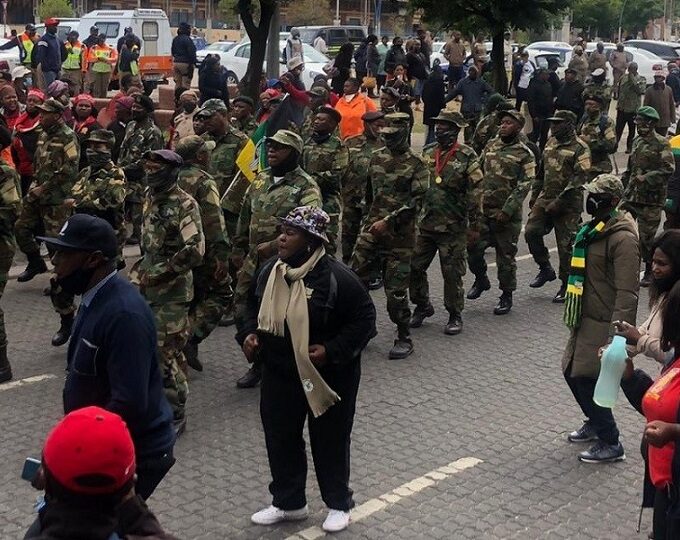
Politically, veterans remain an organized constituency within the African National Congress (ANC), often aligning with populist factions. During Jacob Zuma’s presidency, veterans’ groups played visible roles in internal party struggles. Tensions escalated in October 2021 when a group of veterans allegedly detained government officials while demanding large payouts and land. While the incident exposed deep frustration rather than coordinated insurgency, it underscored how unmet expectations can destabilize post-liberation societies decades after transition.
Sudan demonstrates the risks of veteran dominance in a fragmented state. Fighters from successive civil wars, including those later incorporated into paramilitary forces such as the Rapid Support Forces, became central actors in Sudanese politics. During the 2019 uprising, parts of the security establishment abandoned Omar al-Bashir, facilitating his removal. However, rather than transferring authority to civilians, military leaders retained control through the Sovereign Council. Their continued influence reflected a long history of coups in which armed veterans positioned themselves as guardians of national stability, often at the expense of democratic transition. Subsequent power struggles between military factions contributed directly to renewed conflict, highlighting how unresolved veteran power can fuel state collapse.
Across Africa, liberation veterans occupy an ambiguous space. They are symbols of resistance and national pride, yet their continued dominance often constrains political competition and civilian oversight. As liberation generations age and economic pressures intensify, younger citizens increasingly question why historical sacrifice should confer permanent political authority.
The central challenge is not whether veterans deserve recognition, but whether liberation credentials should override democratic accountability. Where veterans’ influence is unchecked, politics risks becoming securitized and exclusionary. Africa’s post-liberation states now face a critical test: honoring historical struggle while ensuring that governance rests on institutions, performance, and popular consent rather than on the authority of past wars alone.



Related Articles
VETERANS’ ASSOCIATIONS: THE ENDURING POWER BEHIND A NATION’S PROMISE TO THOSE WHO SERVED
In democracies around the world, veterans’ associations are more than social networks....
VETERANS – PENSION REFORM AND THE WELFARE OF AFRICAN MILITARY VETERANS
Across Africa, military veterans embody the sacrifices made for national liberation and...
Honouring Legacy: Military Museums and Memorials Across Africa
Africa’s military history is rich, complex, and often untold. From pre-colonial warrior...


From Combat to Civil Service: Veterans Transitioning into National Leadership
Across Africa, a quiet but significant transformation is underway: former soldiers are...
